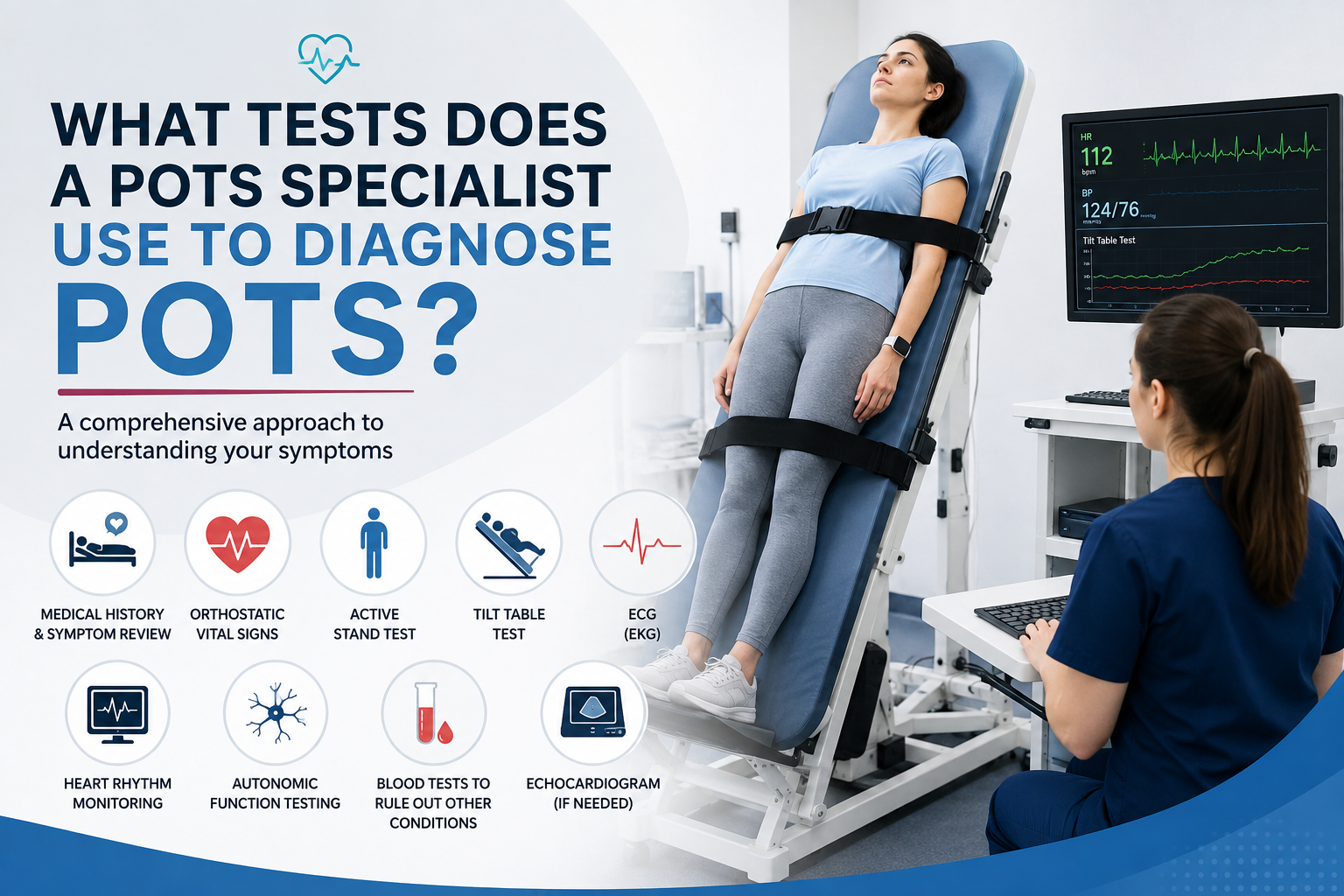

Postural Orthostatic Tachycardia Syndrome (POTS) can cause symptoms such as a rapid heartbeat, dizziness, lightheadedness, fatigue, brain fog, weakness, and exercise intolerance especially after standing. Because these symptoms can overlap with other heart, neurological, hormonal, and metabolic conditions, diagnosing POTS usually requires more than a single test.
A POTS specialist typically combines your medical history, symptom pattern, physical examination, heart-rate and blood-pressure measurements, and specialized autonomic testing to determine whether POTS may be contributing to your symptoms.
What Is POTS?
POTS is a form of autonomic nervous system dysfunction that affects how the body regulates heart rate and blood flow when moving from lying down to standing.
In adults, POTS is generally characterized by a sustained increase in heart rate of at least 30 beats per minute within 10 minutes of standing, without a significant drop in blood pressure that would explain the symptoms. For adolescents, the heart-rate increase threshold is generally higher.
Symptoms can vary considerably from person to person. Common symptoms include:
- Rapid or pounding heartbeat when standing
- Dizziness or lightheadedness
- Fatigue
- Brain fog or difficulty concentrating
- Weakness
- Exercise intolerance
- Headaches
- Shakiness
- Nausea or digestive symptoms
- Feeling faint or near-fainting
- Symptoms that improve after lying down
Because POTS can look different in different patients, a specialist takes a comprehensive approach to diagnosis.
1. Medical History and Symptom Review
The first step is often a detailed discussion of your symptoms.
A POTS specialist may ask:
- When did your symptoms begin?
- Do symptoms become worse when you stand?
- How quickly does your heart rate increase after standing?
- Do symptoms improve when you sit or lie down?
- Have you experienced fainting or near-fainting?
- How do heat, exercise, dehydration, meals, or prolonged standing affect your symptoms?
- What medications and supplements are you taking?
- Have you recently experienced an illness, infection, surgery, or significant change in your health?
Keeping a symptom and heart-rate log can be helpful, particularly if your symptoms fluctuate throughout the day.
2. Orthostatic Vital Signs
One of the simplest ways to evaluate possible POTS is to measure heart rate and blood pressure while you are lying down and after you stand.
A clinician may measure your:
- Resting heart rate
- Resting blood pressure
- Heart rate after standing
- Blood pressure after standing
- Symptoms during the standing period
The measurements may be repeated over several minutes to identify a sustained change.
This test can provide an important initial indication that further autonomic evaluation may be appropriate.
3. Active Stand Test
An active stand test involves moving from lying down to standing while your heart rate, blood pressure, and symptoms are monitored.
The goal is to determine how your cardiovascular system responds to the change in posture.
A significant sustained increase in heart rate accompanied by typical symptoms can support a POTS diagnosis. However, results need to be interpreted in context because dehydration, medications, anemia, infection, thyroid problems, and other conditions can also affect heart rate.
4. Tilt Table Test
A tilt table test is one of the most commonly recognized specialized tests used when evaluating POTS.
During the test, you lie on a motorized table while connected to monitors that measure heart rate and blood pressure. The table is then tilted upward to simulate standing while you remain securely supported.
Your healthcare provider observes:
- Changes in heart rate
- Changes in blood pressure
- Symptoms such as dizziness or nausea
- Whether you experience a significant increase in heart rate after being tilted upright
A tilt table test can be particularly useful when the diagnosis is unclear or when symptoms are difficult to reproduce during a routine office visit.
5. Electrocardiogram (ECG or EKG)
An ECG records the electrical activity of your heart.
Although an ECG does not diagnose POTS by itself, it can help a cardiologist look for other causes of a rapid or irregular heartbeat.
For example, an ECG may help identify certain abnormal heart rhythms that can cause symptoms similar to those experienced with POTS.
This is important because not every episode of a fast heart rate is caused by POTS.
6. Heart Rhythm Monitoring
Depending on your symptoms, a POTS specialist or cardiologist may recommend ambulatory heart monitoring.
A Holter monitor or another wearable cardiac monitor can record your heart rhythm during normal daily activities.
This may help determine:
- How often your heart rate becomes elevated
- Whether episodes occur primarily while standing
- Whether an abnormal rhythm is present
- How your heart rate changes during sleep, exercise, and daily activities
Heart rhythm monitoring can be especially useful if you experience intermittent palpitations.
7. Autonomic Function Testing
Some patients may need more comprehensive autonomic testing.
Depending on the clinical situation, testing may evaluate how the autonomic nervous system responds to changes in position, breathing, and other controlled conditions.
Specialized autonomic testing may help a specialist understand whether there are abnormalities involving the body’s regulation of:
- Heart rate
- Blood pressure
- Blood flow
- Sweating
- Other automatic bodily functions
Not every person with suspected POTS needs every available autonomic test. Testing is generally selected based on the patient’s symptoms and medical history.
8. Blood Tests to Rule Out Other Conditions
There is no single blood test that confirms POTS. However, blood work may be recommended to identify other conditions that can cause similar symptoms.
Depending on your situation, your healthcare provider may consider tests related to:
- Anemia
- Iron deficiency
- Thyroid function
- Electrolytes
- Blood glucose
- Kidney function
- Vitamin deficiencies
- Inflammation or infection
The exact tests depend on your symptoms, history, medications, and physical examination.
9. Echocardiogram
An echocardiogram uses ultrasound to create images of the heart.
It is not a diagnostic test for POTS itself, but a cardiologist may recommend an echocardiogram when symptoms suggest that structural heart disease or another cardiac condition should be evaluated.
The test can assess aspects such as heart structure, pumping function, and heart valves.
Why POTS Diagnosis Can Take Time
POTS symptoms can overlap with many other conditions, which is one reason diagnosis may sometimes take time.
A fast heart rate when standing can have several possible causes, including dehydration, anemia, certain medications, thyroid disorders, infection, prolonged inactivity, and other cardiovascular or autonomic conditions.
A specialist therefore needs to consider the overall clinical picture, rather than relying on heart rate alone.
What Should You Bring to a POTS Evaluation?
Preparing for your appointment can make the evaluation more productive. Consider bringing:
- A list of your symptoms
- When your symptoms started
- A record of heart-rate and blood-pressure readings, if available
- A medication and supplement list
- Previous ECG or cardiac test results
- Relevant laboratory results
- Information about previous diagnoses or treatments
- Notes about triggers such as heat, exercise, dehydration, or prolonged standing
A symptom diary can also help identify patterns that may not be obvious during a short office visit.
When Should You See a POTS Specialist?
Consider discussing your symptoms with a qualified healthcare professional if you repeatedly experience a racing heart, dizziness, lightheadedness, fatigue, or near-fainting after standing.
A POTS specialist can help determine whether your symptoms are consistent with POTS and whether additional cardiac or autonomic testing is appropriate.
If you experience severe chest pain, significant difficulty breathing, prolonged loss of consciousness, or a new or severe heart-rhythm problem, seek urgent medical attention rather than waiting for a routine POTS evaluation.
Frequently Asked Questions
Can a blood test diagnose POTS?
No. There is no single blood test that confirms POTS. Blood tests may be used to rule out conditions such as anemia, thyroid disorders, electrolyte abnormalities, or other problems that can cause similar symptoms.
Is a tilt table test necessary to diagnose POTS?
Not always. Some patients can be evaluated using an active stand test and careful orthostatic heart-rate and blood-pressure measurements. A tilt table test may be useful when the diagnosis is uncertain or more detailed evaluation is needed.
Can an ECG detect POTS?
An ECG does not diagnose POTS. It can, however, help identify other heart-rhythm abnormalities that may cause symptoms similar to POTS.
How long does POTS testing take?
Testing time varies depending on which evaluations are needed. A basic orthostatic assessment may be relatively quick, while a comprehensive autonomic evaluation may require additional time and specialized equipment.
Who diagnoses POTS?
POTS may be evaluated by physicians with experience in autonomic disorders, cardiology, neurology, or related specialties. The most appropriate specialist depends on your symptoms and local availability.